

"If I start SEO today, when will I see results?" It is the first question we hear from almost every business owner, and it is a fair one. You are investing time and money, so you want to know when it will pay off.
The honest answer is that SEO takes months, not days. But "months" is not very helpful on its own. In this guide, we explain why SEO takes time, what speeds it up or slows it down, and what you can realistically expect month by month. We will also point out the promises that should make you walk away.
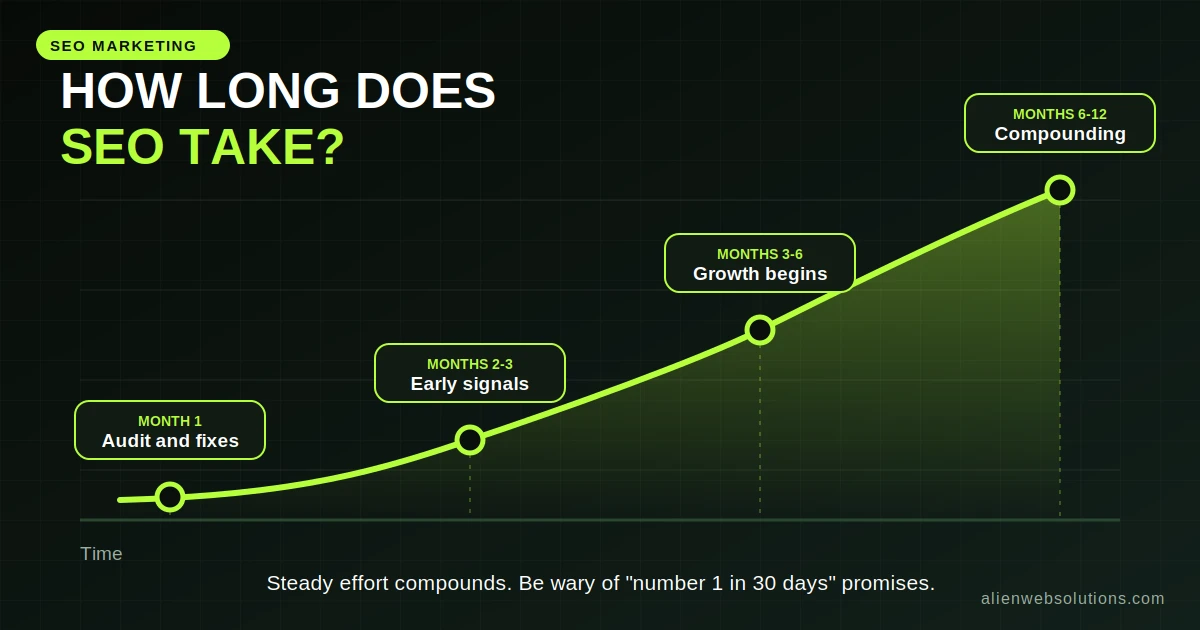
Most businesses start to see early signs of progress within the first one to three months, such as more impressions, better page indexing, and small ranking gains. Meaningful growth in traffic and enquiries usually takes around three to six months, and strong results in competitive markets often need six to twelve months or longer.
These are general ranges, not guarantees. Google itself says, in its guidance on whether you need an SEO, that changes to a site can take time to show their full effect in search results. Your own timeline depends on the factors below.
It helps to know what is happening behind the scenes:
Think of SEO like growing a tree, not flipping a switch. The work you do today builds something that keeps giving results long after.
The first month is mostly groundwork. A good team reviews your website, finds technical problems, checks your competitors, and researches the searches your customers actually use. Fixes begin: broken pages, slow loading, missing titles, and tracking setup.
What you will probably see: Not much in traffic yet. You should see a clear plan and a list of improvements being made.
Now the content and on-page work begins to show. Pages are optimised, new helpful content is published, and your Google Business Profile is improved if you serve a local area. Our article on AI local search and local SEO explains why this is especially important for nearby customers.
What you will probably see: More impressions in Search Console, a few keywords starting to appear on pages two or three, and in local searches, sometimes the first extra calls or direction requests.
This is where steady effort usually starts to pay off. Rankings climb for less competitive searches, traffic grows, and your content begins to bring in real enquiries. This is also the right time to expand, add more pages, and earn quality mentions.
What you will probably see: A noticeable rise in organic visitors and your first leads that clearly came from search.
SEO starts to compound. Older pages gain authority, new content ranks faster, and you begin competing for tougher searches. Results are more stable, and your cost per lead usually becomes much lower than paid ads over time.
What you will probably see: Consistent traffic, better rankings for important searches, and a more predictable flow of enquiries.
It changes where and how you appear, but not the basic need for patience. Customers now discover brands through AI answers, maps, videos, and social platforms, as we explain in our guides on AI search visibility and search everywhere optimization. The upside is that clear, trustworthy content can be picked up in several places at once. The downside is that clicks are harder to win, which we discuss in our article on zero-click search. Measure success by enquiries and brand visibility, not only by clicks.
Because SEO takes time, some companies make promises that sound too good. Be careful if you hear:
Google's own SEO Starter Guide is a good free resource to understand the basics, so you can judge whether what an agency tells you makes sense.
In the early months, do not judge SEO by sales alone. Look at the leading signs first:
If you are still planning your website, factor this in early. Our guide on website cost and timeline explains how to build a site that is ready for SEO from day one.
Paid ads can bring visitors the same day, but they stop the moment you stop paying. SEO is slower to start, but the traffic it builds keeps working without a cost per click. Many businesses use ads for quick results while SEO grows in the background, then rely more on SEO over time.
Early signs often appear within one to three months, meaningful traffic growth usually takes three to six months, and strong results in competitive markets can take six to twelve months or more. The timeline depends on your competition, website, and consistency.
Often yes. Local searches usually have fewer competitors, and a well-optimised Google Business Profile with good reviews can bring calls and visits sooner than national rankings.
No. Nobody outside Google controls rankings, so a guaranteed first position is a warning sign. A trustworthy team will promise honest work and clear reporting, not a fixed ranking.
Common reasons include strong competition, technical problems on the site, thin or generic content, a very new website, or inconsistent effort. A proper audit can show what is holding you back.
Results usually last longer than paid ads, but they can slowly fade if you stop updating content and competitors keep improving. Regular maintenance helps you protect and grow what you have built.
SEO is a long-term investment, not a quick fix. Expect groundwork in the first month, early signals in months two and three, real growth between months three and six, and compounding results after that. The businesses that win are the ones that stay consistent, focus on helpful content, and measure the right things.
If you want an honest SEO plan with a clear timeline and no unrealistic promises, the team at Alien Web Solutions is ready to help. Tell us about your business and goals, and we will show you what is realistic for your market.
