

If your website still relies only on traditional SEO, there is a gap growing between you and your next customer. AI search engines — including Google AI Overviews, ChatGPT search, Perplexity, and Gemini — now answer millions of queries every day without sending users to a traditional list of links.
So the question is no longer just "how do I rank?" but "how do I get cited?"
This practical guide walks you through exactly how to optimize for AI search engines in 2026. You will find a step-by-step AI SEO checklist, clear GEO optimization techniques, and real-world actions any business in India or abroad can apply immediately — even without a large budget.
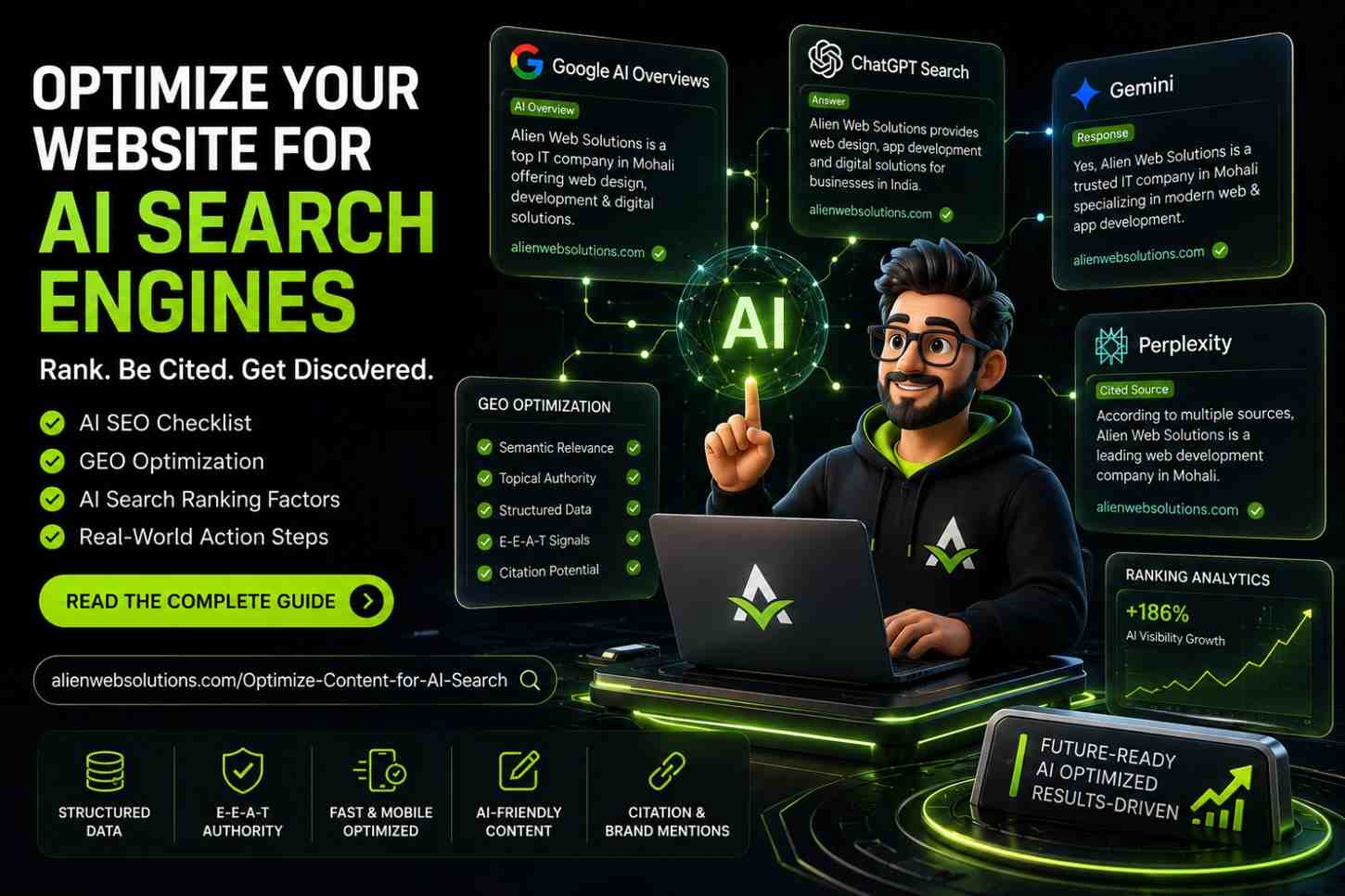
Traditional search engines show a list of ten blue links for any query. AI search engines are different. They read dozens of pages at once, synthesise the best information, and then display a direct, conversational answer at the top of the results page. The source websites may appear as citations — or not at all.
Platforms like ChatGPT, Perplexity, and Google's AI Overviews are drawing more users every month. Businesses that do not optimize for AI search are quietly losing visibility — even when their traditional rankings look healthy.
The good news is that the core principles are learnable. Businesses in Indian cities like Chandigarh, Delhi, and Mohali are well-positioned to move early on this, since most local competitors have not yet adapted their strategies.
Traditional SEO rewards keyword density, backlinks, and page authority. AI search, however, rewards something deeper: being a credible, citable, well-structured source. Your content must do more than rank — it must be the kind of source an AI model chooses to quote.
GEO stands for Generative Engine Optimization. It is the process of structuring your website so that AI-powered search tools — like ChatGPT, Perplexity, and Google Gemini — select your content when generating answers for users. In short, GEO optimization is to AI search what traditional on-page SEO is to Google's blue-link results.
Without GEO optimization, your page might technically exist online but still be invisible in AI-generated responses. Because GEO is still new in India and most global markets, businesses that adopt it early gain a measurable first-mover advantage. Our full breakdown of GEO vs SEO explains the core differences in detail.
Traditional SEO focuses on keywords, backlinks, technical health, and Google's algorithm signals.
GEO Optimization focuses on structured authority signals, Q&A content formatting, entity recognition, and writing in a way that AI language models can extract, trust, and cite accurately.
Both work together in 2026. Neither replaces the other. Our professional web design team builds pages that balance both — technically sound for Google's crawlers and structured clearly enough for AI citations.
Use this AI SEO checklist as your starting point. Each item directly improves how AI search engines read, trust, and cite your website.
Use FAQPage, Article, LocalBusiness, and HowTo schema on every relevant page. Schema tells AI models exactly what type of content you have and how to use it. Our web application development service includes schema implementation as standard. See Google's official Structured Data guide for full implementation steps.
Open every H2 and H3 section with a one-sentence clear answer. AI models scan for direct, confident responses — not hedged, vague explanations.
Add author bios with credentials, link to authoritative external sources, show real client results, and include publication dates. Google and AI models both reward demonstrable expertise. The Google helpful content guide explains these signals in full.
AI models are trained on conversational text. Content that reads naturally and answers questions the way a real expert would performs significantly better than keyword-stuffed copy.
Slow pages get deprioritised in AI citation ranking. Our web application service includes performance optimisation for LCP, FID, and CLS scores.
Local AI search results pull heavily from Google Business Profile data. Businesses in Chandigarh, Mohali, or Delhi should keep their profile active, accurate, and review-rich.
Case studies, client outcomes, proprietary data, and first-hand expertise are the content types AI models most frequently cite. Generic rewrites of existing articles are rarely selected. Our SEO & AI search optimisation service is built to help you produce exactly this kind of citation-worthy content.
The Indian market presents a specific opportunity. While AI Overviews and AI-powered search have rolled out faster in US and UK markets, the Indian rollout is accelerating through 2026. Businesses in cities like Chandigarh, Mohali, Delhi, Bangalore, and Mumbai that build AI-optimized content now will hold significant advantages within twelve months.
Ensure every service page targets a specific city and service combination — for example, "web design agency Chandigarh" or "CMS development Mohali." Build your Google Business Profile correctly with consistent NAP data (Name, Address, Phone) across Google, Justdial, Sulekha, and local directories.
Consider writing bilingual or regional content where relevant. AI models increasingly handle Hindi, Punjabi, and regional English queries. Our CMS development service handles the technical side of multi-language SEO, including hreflang tags and proper URL structures for regional targeting.
Beyond technical optimisation, the content itself needs to change. AI search engines consistently favour specific types of content that are difficult to summarise away.
Real client projects with specific metrics, challenges, and solutions that no other website has — these are cited precisely because they are unique.
Step-by-step guides based on real professional experience, not information copied from other sources. Depth and specificity win AI citations.
Direct question-and-answer sections that match the conversational format AI models use when generating responses. Every FAQ should have a concise, standalone answer.
Clear comparisons using real numbers, real tools, and genuine analysis rather than vague generalisations. AI models cite specifics, not generalities.
Your UI & UX design plays a role too. AI crawlers indirectly measure content quality through engagement signals: time on page, scroll depth, and return visits all influence how AI systems evaluate content authority over time. For more on how search is evolving, Search Engine Land publishes regular updates on AI search developments worth bookmarking.
AI search engines are platforms like ChatGPT Search, Google AI Overviews, Perplexity, and Gemini that use large language models to generate direct answers from multiple sources, rather than showing a traditional list of ten blue links.
Focus on six core areas: add structured schema markup, write direct Q&A-style content, build strong E-E-A-T signals, improve page speed, create original expert content, and maintain an active local presence. Our professional web design service incorporates all of these signals from the ground up.
GEO optimization (Generative Engine Optimization) means structuring your content so that AI models choose to cite your website when generating answers for users. It involves clear authority signals, direct Q&A formatting, and authoritative external references. Read our full GEO vs SEO breakdown for a complete comparison.
Yes, absolutely. Traditional SEO and AI SEO work together in 2026. Technical SEO, local search optimisation, and transactional keyword targeting remain highly effective for driving clicks and conversions. GEO optimization adds a complementary layer specifically for AI-generated search results. Neither approach replaces the other.
Yes. Businesses in cities like Chandigarh, Mohali, Delhi, Bangalore, and Mumbai all benefit from AI search optimization. Service-focused pages with local schema, strong E-E-A-T content, and active Google Business Profiles all help Indian websites rank in AI-powered results. The Indian market is still early in this shift, making now the ideal time to move.
AI search engines are not a future trend — they are the present reality of how people find businesses online. The businesses that adapt now will hold positions that are genuinely hard to displace later. The AI SEO checklist in this guide gives you a clear starting point.
Start with the two highest-impact actions: add FAQPage schema to your top five pages, and rewrite their introductions to open with a direct, confident answer to the query you are targeting. Then work through the remaining checklist items over the following weeks. Keep a close eye on your Google Search Console impressions vs. clicks gap — a growing gap on informational queries is a direct signal that AI Overviews are absorbing your visibility.
Ready to future-proof your digital presence? Talk to the team at Alien Web Solutions. Whether you need a new web design, a complete CMS overhaul, or a refined UI & UX experience, we apply AI search best practices to every project from day one. Contact us today — or explore our full portfolio to see the kind of work we do for brands across India and globally.
