

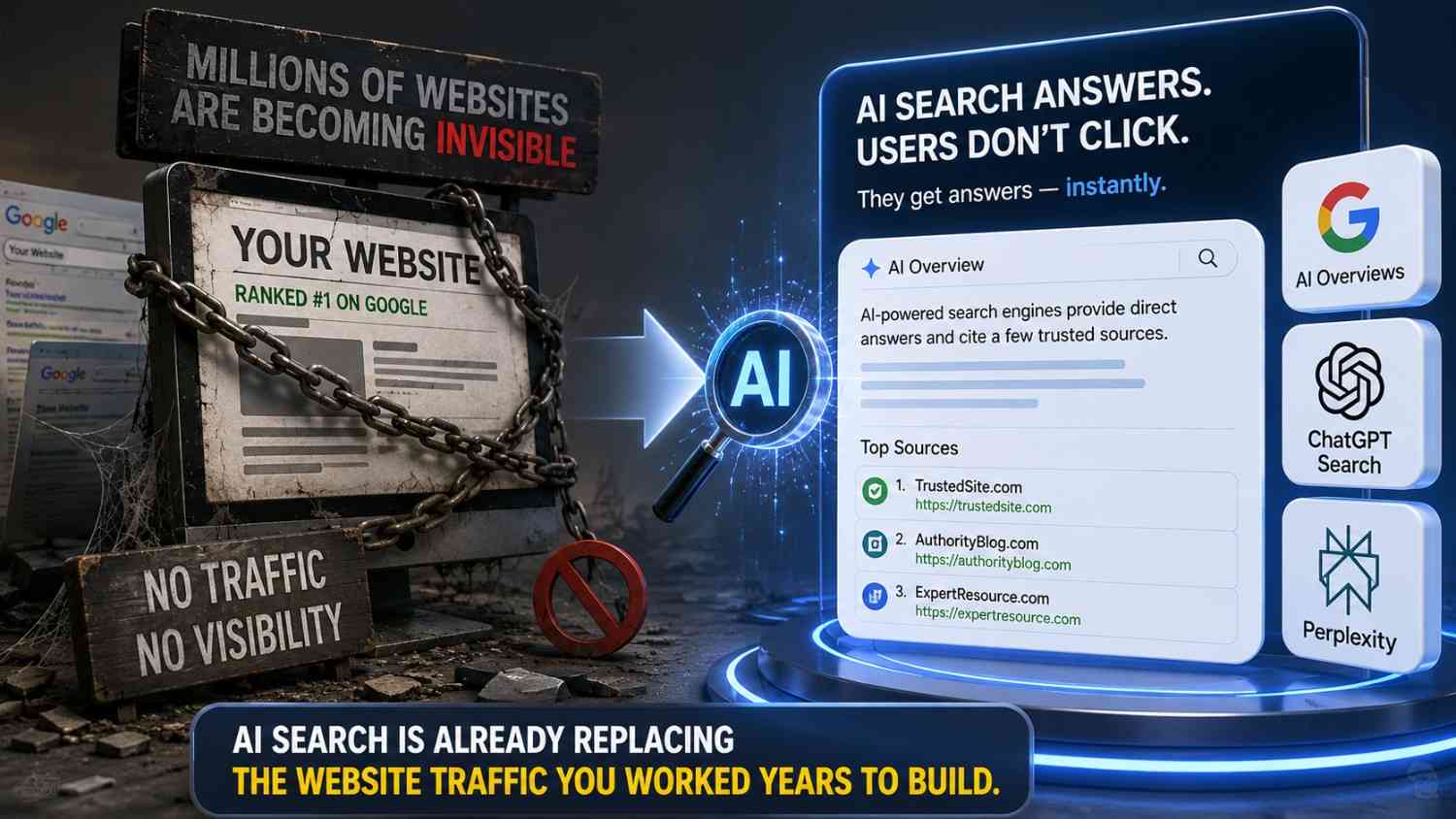
AI search has fundamentally changed who gets found online — and who quietly disappears. Right now, millions of business websites that once ranked on Google's first page are becoming invisible. Not because of a penalty. Not because of a bad update. But because AI-powered search engines like Google AI Overviews, ChatGPT Search, and Perplexity no longer send users to websites the way they used to. Instead, they answer questions directly — and only cite a small handful of trusted, well-structured sources.
So here is the uncomfortable truth: your website can rank number one on Google and still receive almost zero traffic if an AI answer appears above it. The rules have changed. Moreover, most businesses in India and abroad have no idea this is happening to them.
In this guide, you will understand exactly why businesses are disappearing from AI search results, what the new signals of authority look like, and what practical steps you can take today to ensure your website gets cited rather than skipped. If you have not yet read our earlier piece on AI SEO strategies that work in 2026, that is a strong starting point — this article goes deeper into the visibility problem itself.
Traditional search worked simply. You optimized a page, built backlinks, and climbed the rankings. Higher position meant more clicks. That formula drove the entire SEO industry for two decades. However, AI search works on a completely different model.
When a user asks an AI-powered search engine a question today, the system does not return a list of blue links. Instead, it reads hundreds of sources, synthesises the most relevant information, and presents a direct answer — with citations to two or three sources at most. The user gets their answer immediately. Furthermore, they rarely feel the need to click anywhere at all.
This shift is called zero-click search, and it is growing fast. According to industry data, AI Overview-type answers now appear for more than half of all informational queries on Google. For businesses that rely on blog traffic, service page visits, or product discovery through search, this represents a serious threat — one that traditional SEO tactics simply cannot solve on their own.
AI search systems do not cite every ranking page — they cite the most authoritative and clearly structured ones. A page that answers a question in plain language, uses proper schema markup, and demonstrates genuine expertise has a dramatically higher chance of being included in an AI-generated answer. In contrast, a thin page stuffed with keywords and generic content is almost never cited. As a result, the gap between websites that benefit from AI search and those that are ignored by it is growing wider every month. Our SEO and AI search optimization service is designed specifically to close that gap for your business.
Understanding the problem clearly is the first step toward solving it. Therefore, let us look at the three specific reasons most business websites fail to appear in AI search citations — even when they have decent traditional rankings.
AI search engines are built to answer questions. They look for content that opens with a clear, direct response to a specific query. Unfortunately, most business website content is written for impression — it describes services in marketing language rather than answering the real questions customers are typing. A page that begins with "We are a leading digital agency with over 10 years of experience" tells an AI nothing useful. In contrast, a page that opens with "AI search optimization helps businesses appear in AI-generated answers by building structured, authoritative content" gives an AI exactly what it needs to cite you.
Schema markup is a layer of code that tells search engines — and AI systems — exactly what your content means. Without it, AI models have to guess. With it, they know precisely whether your page describes a service, a product, a local business, a review, or a how-to guide. Businesses in Mohali, Chandigarh, and Delhi that implement local business schema, FAQ schema, and service schema consistently outperform competitors in AI-generated local answers. Our web development service builds schema markup into every page from the start, rather than adding it as an afterthought.
AI systems do not just look at your website in isolation. They cross-reference your brand against mentions, reviews, citations, and presence across the broader web. A business that appears consistently on Google Business Profile, industry directories, reputable review platforms, and authoritative external websites carries far more weight with an AI model than one that only has a standalone website. Building this cross-platform authority is therefore not optional — it is the foundation of modern AI search visibility.
AI search visibility is not about gaming an algorithm. It is about becoming the kind of source that an AI system genuinely trusts. Moreover, that trust is built through a specific combination of signals that most businesses have not yet focused on. Here is what actually matters.
Google's own quality guidelines make it clear that AI systems evaluate content through the lens of E-E-A-T — Experience, Expertise, Authoritativeness, and Trust. Practically speaking, this means your content needs to demonstrate that a real expert wrote it, that your business has verifiable credentials, and that your information can be trusted. Adding author bios, citing real data, including case studies, and linking to authoritative external sources all strengthen these signals. Additionally, having your business featured in respected publications — even local ones — builds the kind of third-party validation AI systems weigh heavily.
AI models favour sources that demonstrate deep knowledge on a specific topic over those that cover everything shallowly. Rather than publishing one blog post about every digital marketing trend, build a tightly interconnected set of pages that cover one topic from multiple angles. For example, a web design agency in Mohali would benefit more from publishing five in-depth, linked articles about Shopify development than from scattering effort across fifty unrelated topics. This topical depth signals genuine expertise to AI systems — and to Google's own crawlers. Our CMS development service makes it straightforward to build and manage this kind of content architecture.
Knowing what AI search rewards is useful. However, knowing what to actually do about it is what matters for your business. Consequently, here is a grounded, actionable approach to building AI search visibility — one that works whether you are based in Chandigarh, Delhi, Mumbai, or serving international clients.
Start with your highest-traffic service and product pages. Identify the two or three questions a customer would most likely ask about that service. Then rewrite the opening paragraph of each page to answer those questions directly and clearly, in plain language. This single change — moving from marketing copy to answer-first content — is the most impactful thing most businesses can do immediately for AI search optimization.
Every service page, product page, and blog post should include a FAQ section with three to five questions written in natural, conversational language. Moreover, each FAQ section should be marked up with FAQ schema so AI search engines can read and cite it directly. Questions that match the "People Also Ask" boxes on Google are especially valuable because they directly reflect the queries AI systems are answering at scale.
For businesses serving clients in India — particularly in Punjab, Haryana, Delhi NCR, and beyond — local authority signals remain one of the strongest paths to AI search visibility. Keep your Google Business Profile fully updated, earn genuine customer reviews, and ensure your business name, address, and phone number are consistent across every online directory. These signals feed directly into the AI systems that answer local queries like "best web design company in Mohali" or "SEO agency near Chandigarh."
One of the most powerful AI search optimization strategies is also the most overlooked: getting cited by other trusted websites. When reputable platforms link to your content or mention your brand, AI systems treat your business as a more reliable source. Guest articles on industry blogs, being featured in press releases, and contributing expert quotes to news outlets all build the kind of external citation profile that pushes your website into AI-generated answers. Think of it as the modern equivalent of backlink building — except the value goes far beyond traditional link equity.
Consider a local accountancy firm in Delhi that had ranked consistently for the phrase "GST filing services Delhi" for three years. When Google AI Overviews began appearing for that query, their click-through rate dropped by over 60% — despite maintaining their first-page position. After working with an AI search optimization specialist, they made three focused changes: they rewrote their service page to open with a direct answer to "how does GST filing work for small businesses," added structured FAQ schema, and published two original guides drawing on their own client case studies.
Within four months, their website was being cited in AI Overviews for several related queries. More importantly, the traffic that did arrive converted at a higher rate — because users who click through from an AI citation already trust the source they are visiting. This pattern holds true across industries and locations. Whether you run an e-commerce brand, a professional services firm, or a local shop in Jalandhar, the principle is the same: authority and structure drive AI visibility.
AI search refers to search engines that use large language models to generate direct answers rather than simply listing links. Google AI Overviews, ChatGPT Search, and Perplexity are examples. Instead of showing ten blue links, they synthesize information from multiple sources and present a single answer — citing only the most authoritative sources. This means ranking well is no longer enough on its own; you also need to be structured and trustworthy enough for AI systems to cite you.
It depends on how well your website is optimized for AI citation. Websites that answer questions directly, use schema markup, and demonstrate genuine expertise often see increased referral quality even if raw click volume changes. Websites that rely on thin informational content and do not demonstrate clear authority will see significant drops. Therefore, adapting your content and technical setup now is the most effective protection against AI-driven traffic loss.
Focus on three things: write content that directly and clearly answers specific questions your customers are asking; implement comprehensive schema markup including FAQ, LocalBusiness, and Service schemas; and build consistent brand authority across Google Business Profile, external directories, and reputable third-party websites. Together, these signals tell AI systems that your business is a trustworthy, expert source worth citing.
Absolutely. In fact, smaller businesses in cities like Chandigarh, Mohali, Ludhiana, and Jaipur often have a significant advantage because the local AI search landscape is less competitive than global markets. A well-structured local business website with genuine reviews, clear service descriptions, and proper schema markup can achieve strong AI visibility in local queries much faster than a large brand can dominate national ones. The opportunity is real, and it is available right now.
Most businesses that implement structured content changes, schema markup, and consistent local authority signals start seeing measurable improvements in AI citation frequency within three to five months. However, some quick wins — like being included in AI Overviews for specific local queries — can appear within weeks of making targeted on-page changes. The key is to treat AI search optimization as an ongoing investment rather than a one-time fix.
AI search is not a future challenge — it is happening right now, and the gap between businesses that have adapted and those that have not is widening every month. The good news is that the path forward is clear. Build content that answers real questions. Implement proper schema markup. Demonstrate genuine expertise. Maintain consistent authority signals across the web. And invest in the technical foundation that allows AI systems to read, understand, and cite your pages confidently.
This is not about chasing an algorithm. It is about building the kind of online presence that genuinely serves your customers — and that AI systems recognize as trustworthy enough to recommend. The businesses that take these steps now will hold durable visibility advantages as AI search continues to grow.
Ready to future-proof your website for AI search? Explore our AI search optimization and SEO services, see how our web development team builds technically excellent, AI-ready websites, or browse our portfolio of completed projects. When you are ready to build a presence that AI search cannot ignore, contact Alien Web Solutions today.
