

You hit publish. Traffic trickles in through Google. Then something shifted in 2025 — a big chunk of your potential audience stopped clicking blue links altogether. They asked ChatGPT. They opened Gemini. They checked Perplexity. And your content? Nowhere to be found.
This guide covers exactly how to optimize content for AI search so that models actually cite, quote, and reference your pages. We break down how AI search engines decide what to surface, the ranking factors that matter most, and the practical changes you can make today — whether you run a business in Delhi, Mumbai, or serve clients globally.
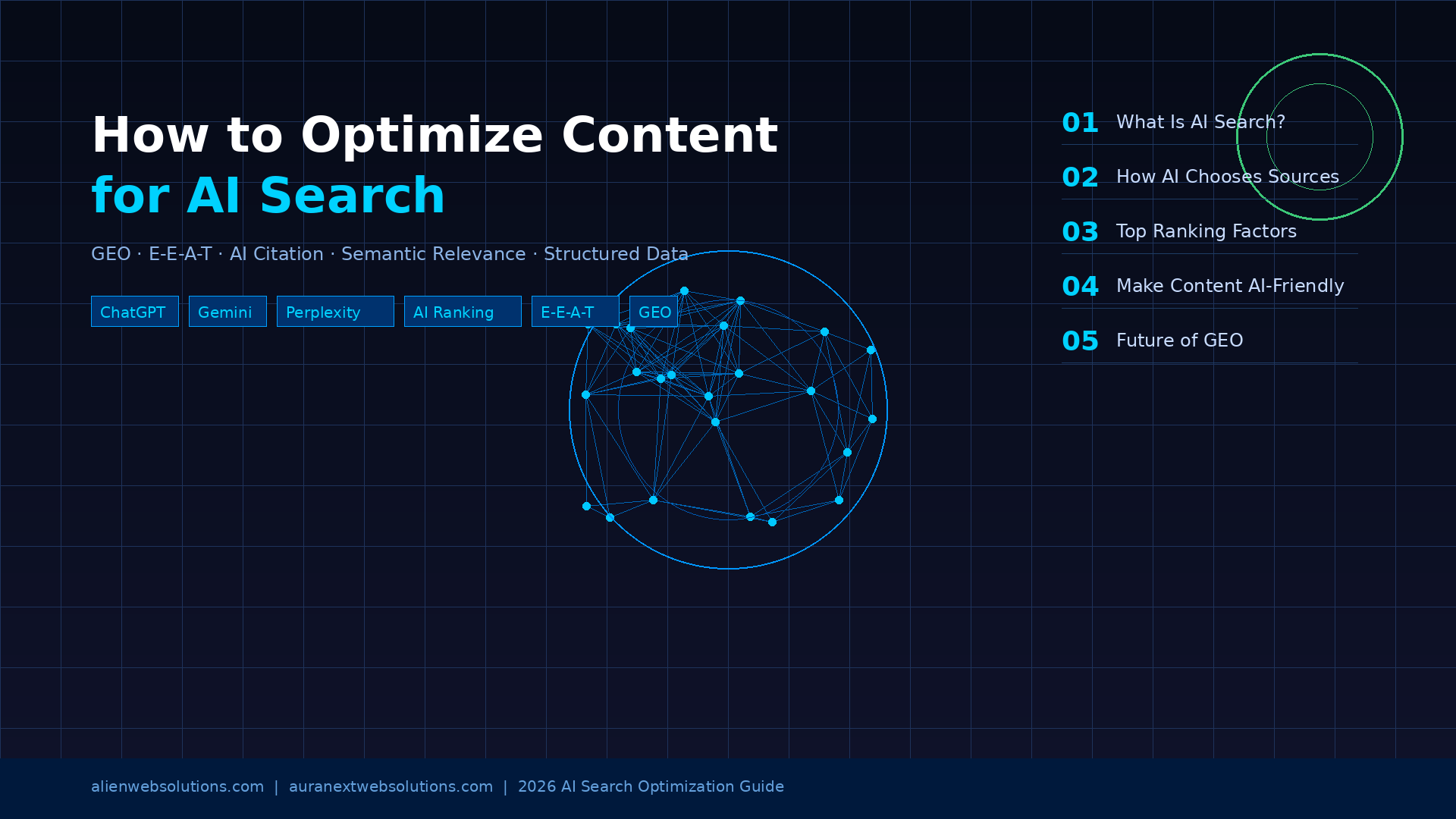
AI search is not a smarter Google. It is a fundamentally different model. Instead of returning a list of links, tools like ChatGPT Search, Google's AI Overviews, Gemini, and Perplexity generate a direct answer — synthesised from multiple sources — and credit those sources with citations.
This shift is called Generative Engine Optimization (GEO). Traditional SEO gets you ranked. GEO gets you cited. Both matter now, but GEO is what most businesses are still missing.
If you're new to how AI search differs from traditional rankings, our breakdown of GEO vs SEO covers the core distinction in full — and is a useful starting point before diving into the strategies below.
Each platform has its own blend of signals, but the core logic is the same: find the most accurate, trustworthy, and clearly written answer — then attribute it.
ChatGPT pulls live web results via Bing and prioritises pages that answer questions directly, use clear heading structure, and demonstrate expertise. Authoritative domains from India and abroad rank well here when they follow structured formatting.
Gemini leans heavily on Google's existing quality signals — Core Web Vitals, E-E-A-T, and Knowledge Graph connections. If your site already ranks well in traditional search, you have a solid foundation. Our SEO & AI search optimisation services cover the additional GEO layer on top of your existing SEO strategy.
Perplexity is arguably the most citation-transparent of the three — it shows users exactly which pages it referenced and why. Content that earns citations here tends to be factual, specific, and well-linked externally.
Want to show up in AI-generated answers? These six signals consistently drive citation probability across all major platforms.
Knowing the factors is step one. Here is what to actually do when writing or updating content — applicable whether your audience is in India or anywhere globally.
AI search queries are conversational. Structure H2 and H3 headings as questions and answer them directly in the first 2–3 sentences underneath. AI models pull these short, direct paragraphs as answer candidates.
Data-backed statements are more citable than vague claims. Link statistics to credible external sources or published research. This builds the trustworthiness AI favours.
One H1. Multiple H2s for main sections. H3s for subsections. H4s only where a subsection needs further breakdown. Never skip heading levels — a broken structure is a citation killer.
Every blog post needs Article schema at minimum. Add FAQPage schema wherever you include questions and answers. For service pages, use Service and LocalBusiness schema — especially important for businesses serving clients across India. Our web designing services include schema implementation as standard, and our CMS development keeps those foundations solid.
Create and verify your Google Business Profile. Maintain consistent NAP (Name, Address, Phone) across all directories. Get featured in industry roundups and news articles. A well-structured website is the foundation — our UI & UX design services ensure both humans and AI crawlers can navigate your site effortlessly.
AI systems can detect thin, recycled content. Original research, proprietary data, and genuine expert opinion are the hardest things for AI to synthesise from scratch — making them your highest-value content assets. Our guide on AI SEO strategies that work in 2026 explains why human oversight matters more than ever.
AI search is moving faster than traditional SEO ever did. A few shifts worth preparing for now:
GEO (Generative Engine Optimization) is the practice of structuring content so AI-powered search engines like ChatGPT, Gemini, and Perplexity surface it in generated answers — not just blue-link results. It focuses on citation probability rather than click-through rate. Read our full breakdown of GEO vs SEO for a complete comparison.
Focus on E-E-A-T signals, use clear structured data, write concise factual paragraphs, earn citations from authoritative sources, and keep content fresh. Answering specific questions directly under appropriately labelled headings dramatically improves your chances.
Yes. AI models heavily favour content from demonstrated experts with real experience. Clear author credentials, first-hand data, and trustworthy sourcing directly improve citation probability across ChatGPT, Gemini, and Perplexity.
Absolutely. Schema markup like FAQPage, HowTo, and Article helps AI engines parse and quote your content accurately. It is one of the fastest, lowest-effort wins for increasing citation likelihood. Our web application development team can implement this across your entire site.
Every 60–90 days for high-priority pages. AI models prefer fresh, accurate information. Adding updated statistics, new examples, or refreshed publication dates signals recency and improves citation ranking against older, similar content.
AI search is not replacing SEO — it is expanding what SEO means. The fundamentals still hold: write well, build authority, earn trust. But now you need to layer in GEO-specific practices — structured data, direct Q&A formatting, citation-worthy facts, and entity authority — to stay visible where ChatGPT, Gemini, and Perplexity are becoming the new front page of the internet.
Start with one page. Audit its heading structure, add FAQPage schema, cite two authoritative external sources, and refresh it with something new. That's the first step toward consistent AI citation.
Ready to future-proof your digital presence? Talk to the team at Alien Web Solutions. Contact us today — or explore our full portfolio to see the kind of work we do for brands across India and globally.
