

Entity SEO is no longer a specialist concept reserved for technical SEO experts — it is now one of the most important ranking factors your website needs to get right. Most businesses in India and globally are still competing on keywords alone. Meanwhile, Google has already moved on. It is no longer just matching words on a page to a search query. Instead, it is asking a deeper question: does Google actually understand who this business is?
If Google cannot confidently answer that question about your brand, your rankings will suffer — no matter how much content you publish or how many backlinks you build. This is the core problem that entity optimization solves.
In this guide, you will learn exactly what entities are, why Google trusts them, how the Knowledge Graph connects them, and — most importantly — what your business can do right now to build the brand authority that AI systems and search engines understand and reward. If you have already read our earlier breakdown of how AI search marketing has changed the customer journey, this guide goes deeper into the structural foundation that makes that visibility possible.
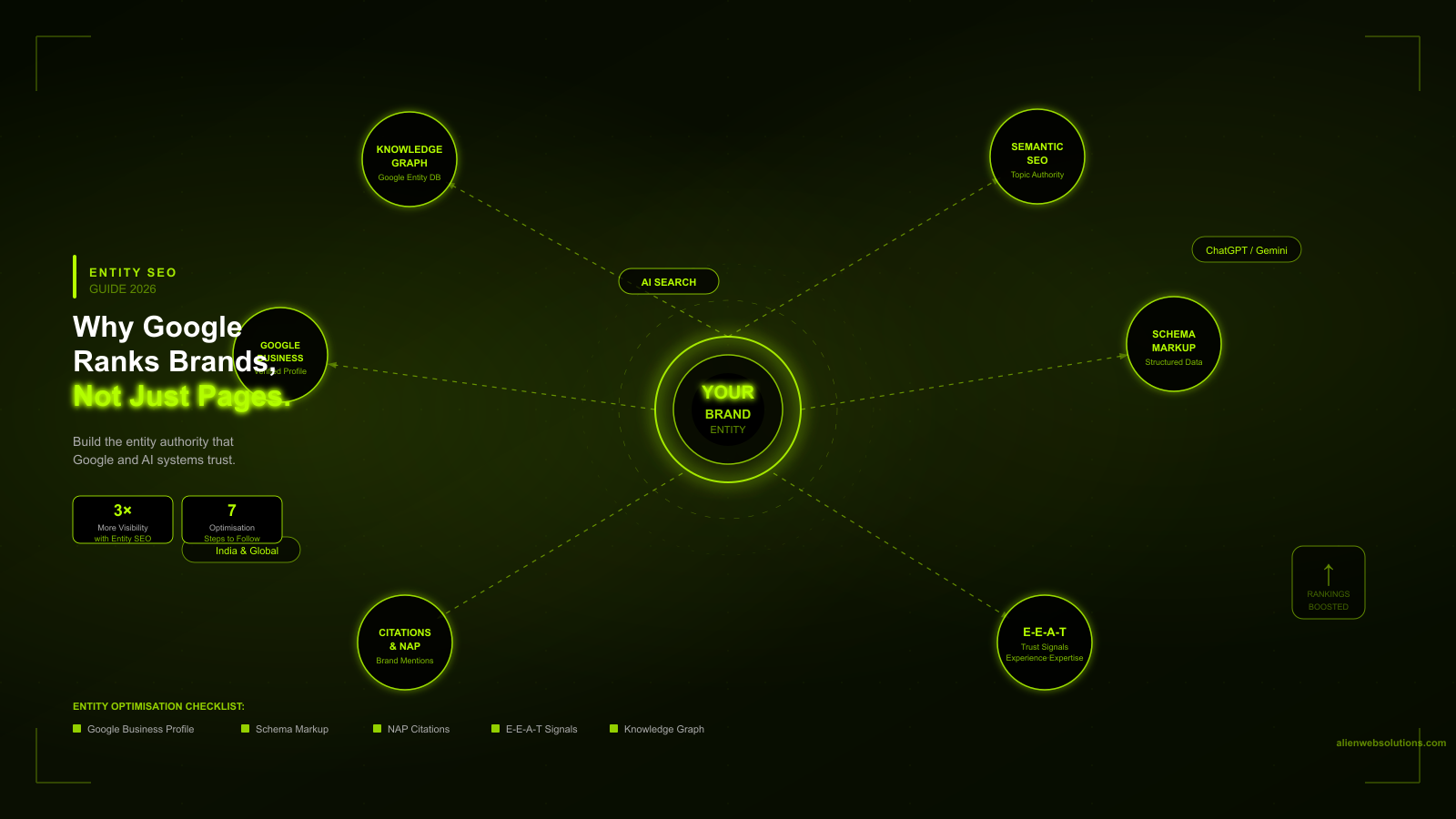
An entity is anything that Google can distinctly identify and understand — a person, a place, a business, a product, a concept. Unlike a keyword, which is just a string of text, an entity carries meaning. It has relationships to other entities. It has attributes. It has a context. And that context is exactly what Google uses to evaluate relevance, credibility, and trust.
Think of it this way. The word "apple" is a keyword. Apple Inc., the technology company based in Cupertino, is an entity. Google knows Apple Inc. has a specific CEO, a product range, a founding date, and thousands of verified relationships with other entities — developers, retailers, competitors. When someone searches "best smartphone 2026," Google does not just look for pages containing those words. It looks for entities it trusts on that topic. Consequently, if your business is not recognised as a distinct, well-understood entity in Google's systems, your pages compete at a significant disadvantage from the very start.
For businesses across India — whether you are a web design studio in Mohali, an e-commerce brand in Delhi, or a consultancy in Bengaluru — entity optimization is the structural work that tells Google your business is real, authoritative, and worth ranking.
Traditional SEO optimises for keywords. Entity SEO optimises for meaning. When you target a keyword like "web design company Chandigarh," you are telling Google which words your page contains. However, when you build entity signals, you are telling Google who your business is, what it does, where it operates, who it serves, and how it relates to other established entities. That is a far richer signal — and it is far harder for competitors to replicate quickly. Furthermore, it is the kind of signal that AI systems like Google AI Overviews and ChatGPT specifically look for when deciding which businesses to recommend.
The Google Knowledge Graph is the database Google uses to store and connect entities. It contains billions of facts about people, organisations, locations, and concepts — all linked together in a vast web of relationships. When Google indexes your website, it is not simply cataloguing your content. It is actively trying to connect your business to the right node in that graph.
If it can successfully connect your brand to the Knowledge Graph — meaning it can recognise you as a distinct, verifiable entity — it gains a much richer understanding of what you do and who you serve. As a result, it can rank you more confidently for a broader range of relevant searches. If it cannot make that connection, your brand remains an anonymous collection of web pages rather than a trusted entity with authority.
Being listed in the Google Knowledge Graph is not automatic. Moreover, it is not guaranteed by having a Google Business Profile, though that certainly helps. It requires a consistent, coherent identity across your website, your structured data, your external mentions, and your broader digital presence.
The simplest way to check whether Google recognises your business as an entity is to search your brand name. If a Knowledge Panel appears on the right side of the results — showing your business name, category, location, and key attributes — Google has successfully mapped your brand as an entity. If no panel appears, or if the panel shows inaccurate information, your entity signals need work. Our SEO and entity optimization service at Alien Web Solutions specifically targets this Knowledge Graph clarity, building the structured signals your brand needs to earn a confident, accurate panel.
There is a ceiling to what keyword-based SEO can achieve for your brand. You can rank for a specific term, but if Google does not understand the full context of your business, you will struggle to break through that ceiling — especially for competitive, high-value searches. Semantic SEO and entity optimization remove that ceiling by giving Google the contextual understanding it needs to confidently associate your brand with an entire topic area, not just individual search queries.
Consider two web design agencies. Both have excellent websites, strong technical SEO, and regular content output. The first agency has invested in entity optimization — their services, team, location, client sectors, and expertise are all clearly structured and consistently represented across every digital touchpoint. The second agency has not. For a query like "best web design agency for e-commerce in India," Google's entity-aware ranking systems will strongly favour the first agency — not because their page content is better, but because their brand identity is more legible to Google's intelligence systems.
Therefore, entity authority compounds over time in a way that keyword rankings simply do not. Each new structured citation, each additional schema property, each verified external mention strengthens the entity signal further. Competitors who have not started this work face an increasingly large gap to close.
One of the most consistent patterns across major Google algorithm updates in recent years is that businesses with strong entity signals tend to be more stable. Businesses that rely purely on keyword manipulation tend to see sharp ranking fluctuations with each core update. This makes intuitive sense: Google's updates are largely aimed at improving its understanding of quality and trust. Brands it already understands and trusts as verified entities are naturally less vulnerable to those recalibrations. In contrast, brands that exist only as anonymous keyword-targeting pages face volatility with every significant change.
Building strong entity signals is methodical work. It is not about quick wins or technical shortcuts. Instead, it is about systematically constructing a coherent, consistent, and credible digital identity that Google can confidently map to its Knowledge Graph. Here is a practical checklist to get started.
Your business name, description, service categories, location, and founding information must be completely consistent across your website, your Google Business Profile, your social media profiles, and every external directory. Even minor inconsistencies — a slightly different business name, an outdated address, a different primary category — create confusion in Google's entity mapping. Consequently, they weaken your Knowledge Graph signal. Start by auditing every digital touchpoint your brand occupies and enforcing strict consistency across all of them.
Schema markup is the structured data language that explicitly tells Google what your entities are. At minimum, every business website needs Organisation schema — defining your name, URL, logo, contact details, and social profiles. Additionally, you need LocalBusiness schema if you serve a geographic area, Service schema for each service you offer, Person schema for key team members, FAQ schema on relevant pages, and Review schema wherever you display testimonials. Our web development team implements all of this as standard, because schema is not optional for serious entity SEO — it is foundational. For the technical specification, Schema.org's Organisation specification remains the authoritative reference.
Your About page is one of the most important entity-building assets on your website, yet most businesses treat it as an afterthought. A strong entity-optimized About page clearly states who your business is, what it does, who founded it, when it was established, where it operates, and which industries or audiences it serves. Furthermore, it should naturally mention the real people behind the business — linking to their individual profiles — and describe your specific areas of expertise in clear, structured language. This depth of self-description directly helps Google map your brand within the Knowledge Graph.
Google does not rely solely on what you say about yourself. It cross-references your entity against what other credible sources say about you. Guest articles in industry publications, media mentions, citations in business directories, and being referenced on partner websites all contribute to your entity authority. Think of each external mention as a vote that says: "this business exists, it is real, and it is relevant to this topic." Over time, these citations compound into a reputation that Google's systems recognise and reward. For businesses in India, regional publications, sector-specific portals, and local business associations are all valuable sources of credible entity mentions.
Entity SEO and content strategy are inseparable. To be recognised as an authoritative entity on a topic, your website needs to demonstrate genuine, comprehensive expertise in that area through its content. This means creating in-depth, accurate, useful guides on the topics your business is genuinely expert in — not broad, surface-level posts designed purely to capture keywords. Each piece of high-quality, topically relevant content you publish strengthens the association between your entity and that subject area in Google's understanding. Our guide on AI search visibility for business websites covers how this content authority translates directly into AI-generated answer visibility.
Consider a boutique interior design firm in Gurugram that had been struggling with inconsistent rankings despite a strong portfolio and reasonable backlink profile. Their core problem was an entity problem. Their business name appeared in four different formats across their website and external profiles. They had no schema markup beyond a basic title tag. Their About page contained only two paragraphs of vague language. And their Google Business Profile category did not match the services they primarily offered.
After a structured entity optimization project — enforcing name consistency, implementing full Organisation and LocalBusiness schema, rewriting their About page, and building citations in three relevant directories — their Knowledge Panel appeared within six weeks. Moreover, their ranking positions for competitive interior design terms in the Delhi NCR market improved significantly over the following three months, with less volatility during a subsequent core update than they had historically experienced.
This outcome is not unusual. The pattern repeats across industries and geographies. Whether you run a legal practice in Chennai, a manufacturing business in Pune, or a digital agency in Mohali, the Google Knowledge Graph SEO principles are consistent. Businesses that take the time to build legible entity signals reap compounding ranking and visibility benefits that keyword tactics alone cannot deliver. Browse our project portfolio to see how we have applied these principles for real clients.
Entity SEO is the practice of optimising your brand so that Google can recognise and understand it as a distinct, trusted entity in its Knowledge Graph — rather than just a collection of keyword-targeting pages. It matters in 2026 because Google's ranking systems, as well as AI assistants like AI Overviews and ChatGPT, now rely heavily on entity understanding when deciding which businesses to recommend. Brands that Google understands as verified entities consistently outrank those it does not.
Traditional SEO focuses on matching keyword phrases to search queries. Entity optimization focuses on building the structural identity signals — schema markup, consistent NAP data, Knowledge Graph citations, topical authority content — that help Google understand who your business is, not just what words your pages contain. Both are complementary; however, entity signals provide the contextual foundation that makes all other SEO work more effective. Therefore, businesses that invest in entity optimization typically see greater stability and broader relevance across their target search landscape.
Search your business name directly in Google. If a Knowledge Panel appears on the right side of the results page — showing your business name, category, location, and key attributes — your business is mapped as an entity in the Knowledge Graph. Additionally, you can use Google's Knowledge Graph Search API to check for your entity directly. If no panel appears, or if the panel is missing key information, your entity signals need to be strengthened through structured data, consistent NAP data, and credible external citations.
It is especially relevant. For local businesses in India — whether in Chandigarh, Mumbai, Hyderabad, or smaller cities — entity optimization directly improves local search visibility, Google Maps rankings, and AI-generated local recommendations. Furthermore, the competition for local entity signals is typically lower than for national terms, meaning the investment delivers proportionally larger returns for smaller businesses. A consistent Google Business Profile, local schema markup, and citations in regional directories are the foundation of strong local entity authority.
Initial improvements — such as a Knowledge Panel appearing or schema-enhanced rich results displaying — can be visible within four to eight weeks of implementing the foundational changes. Broader entity authority and the ranking improvements that follow typically develop over three to six months as Google's systems process and validate the new signals. However, the compounding nature of entity authority means that businesses which begin this work now build an increasingly difficult advantage for competitors to close over time.
The shift from keyword-based SEO to entity-based SEO is not a trend to monitor — it is a transition that has already happened. Google's ranking systems already weight entity signals heavily. AI assistants already rely on Knowledge Graph data when forming recommendations. The businesses that have invested in entity SEO are already pulling ahead in ways that are increasingly difficult for late-movers to close.
The good news is that the steps required are concrete and achievable. Define and enforce a consistent brand identity. Implement comprehensive schema markup. Build an About page that reads like an entity profile. Earn credible external citations. Create topical authority content that demonstrates genuine expertise. Each of these actions strengthens your entity signal, compounding over time into a brand authority advantage that keyword tactics simply cannot replicate.
Ready to build an entity-optimized digital presence? Explore our SEO and digital marketing services, see how our web development team builds entity-ready site architectures, or browse our client portfolio to see real results in action. When you are ready to take the next step, contact Alien Web Solutions today.
