

If you are weighing up WooCommerce vs Shopify right now, you have probably already read five articles that say the same thing: Shopify is easier, WooCommerce is more flexible. That is technically true — but it is also not nearly enough to help you make a confident decision for your actual business.
We have built and launched stores on both platforms for clients across Mohali, India, and internationally. Here is the honest breakdown — covering real pricing, SEO performance, and long-term fit — that most comparison guides skip.
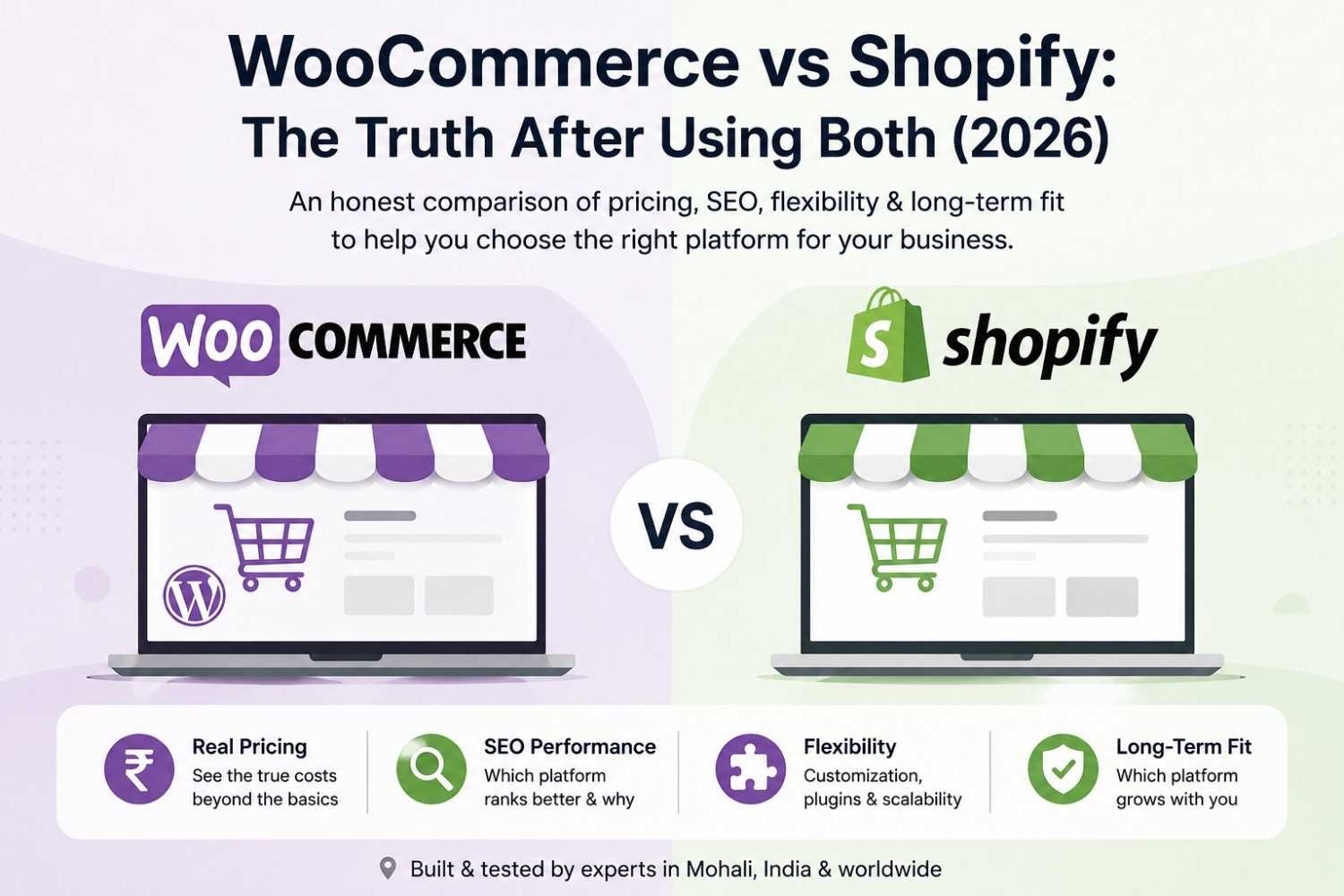
Before you compare features, understand what type of product each one is.
Shopify is a fully hosted SaaS platform. Your monthly subscription covers hosting, security patches, and software updates. Everything runs on Shopify's infrastructure. You get reliability and a polished experience in exchange for operating within a defined ecosystem.
WooCommerce is a free, open-source plugin for WordPress. You control your own hosting environment, your data, your URL structure, and every aspect of your site's functionality. That ownership is genuinely powerful — but it puts responsibility on you or your CMS development partner to manage the technical side.
In the WooCommerce vs Shopify debate, neither model is wrong. The right choice depends entirely on how your business is built and where it is going.
Shopify pricing in 2026 sits at $39/month (Basic), $105/month (Shopify plan), and $399/month (Advanced). Those headline figures do not include the apps most stores need — email marketing, reviews, upsell tools, and analytics — which typically add another $30–$150/month depending on your stack.
WooCommerce pricing starts at zero for the plugin itself. Your real costs break down as:
For businesses in Mohali and across India launching their first store or scaling a growing one, WooCommerce consistently has a lower entry cost. Shopify, on the other hand, offers a more predictable monthly spend and removes the burden of server management entirely.
A practical rule: WooCommerce costs less when you have a capable web design and development partner. Shopify costs more but demands less technical overhead from your team.
Shopify vs WordPress SEO is where the opinions get loudest — so here is the honest answer.
Both platforms can rank extremely well on Google. SEO performance depends far more on your content strategy, backlink profile, and technical setup than on which platform you chose. That said, WooCommerce running on WordPress gives you deeper native control over every SEO variable: full URL customization, advanced schema markup, unlimited blog depth, and powerful plugin integrations like Rank Math that Shopify does not replicate natively.
Shopify has improved meaningfully for SEO in recent years. Its core Web Vitals scores are solid, and stores built correctly on Shopify absolutely rank for competitive terms. The real limitations — a fixed /products/ and /collections/ URL format, thin filter and tag pages, a relatively shallow blogging system — are manageable but require extra effort.
If you are serious about building organic traffic through long-form content and strategic publishing, WooCommerce with WordPress gives you the better foundation. For context, we have written a dedicated guide on AI SEO strategies that work in 2026 that covers exactly how modern content strategy intersects with platform choice.
For an authoritative external reference, Google's own Search Central documentation on e-commerce SEO is the clearest guide to what actually affects how your store ranks.
Shopify is the stronger choice when speed-to-market, simplicity, and a polished out-of-box experience are the priority. If you want to launch a focused product catalog quickly, without a developer on retainer, Shopify delivers a professional store with minimal friction.
Its checkout is consistently one of the best-converting in the industry. The mobile experience is polished by default. App integrations for payments, shipping, and reviews are available in a few clicks. If the brief is "launch fast and sell immediately," Shopify earns its subscription fee.
We have built and customized Shopify stores for fashion, lifestyle, and product brands — you can see some of that work in our portfolio. And if you already have a Shopify store and want to improve its theme, performance, or conversion structure, our Shopify theme customization guide walks through exactly how to do that in 2026.
WooCommerce is the stronger choice when your business needs flexibility, content power, and full platform ownership. Complex product variations, custom shipping logic, membership or subscription features, multi-language support, and deep integration with Indian payment gateways — WooCommerce handles all of this natively and without workarounds.
There is also a meaningful financial point for Indian businesses: Shopify Payments is not available in India as of 2026, which means Shopify charges transaction fees of 0.5%–2% on every order when you use third-party gateways like Razorpay or Instamojo. WooCommerce integrates with these gateways natively at no extra platform fee. At real sales volumes, that difference adds up quickly.
WooCommerce also lives inside WordPress, so your store and your content strategy share one ecosystem. That is a genuine SEO advantage for brands building organic traffic as a core acquisition channel — not just a technical detail.
For a deep look at what WooCommerce stores and WordPress builds look like in practice, visit our CMS Development services page to see the platforms and approaches we work with.
WooCommerce on WordPress gives you more control over every SEO variable — URL structure, schema, content architecture, and technical configuration. For content-driven, organic-first businesses, it is the stronger foundation. Shopify handles SEO competently and ranks well when set up correctly, but it works best for brands whose primary acquisition channel is paid traffic rather than organic search.
WooCommerce costs less upfront since the plugin itself is free, but real costs include hosting, premium plugins, and developer support. Shopify runs $39–$399/month plus app fees. For Indian businesses working with an experienced development team, WooCommerce is typically more affordable overall — especially at lower monthly revenue levels.
WooCommerce is the most capable and widely used Shopify alternative, particularly for businesses that want full platform ownership. BigCommerce is a strong option for larger product catalogs. For fully custom stores, a headless or full-stack build — like the web application solutions we offer — is increasingly popular among funded D2C brands that need complete control.
Yes, and it happens regularly. A proper migration covers product and customer data transfer, URL redirect mapping, and SEO continuity planning. Done incorrectly, it can result in meaningful organic traffic loss — so working with an experienced team matters significantly here.
Shopify works in India, but the absence of Shopify Payments means third-party gateway fees apply on every transaction. WooCommerce integrates natively with Razorpay, PayU, and CCAvenue at no additional platform cost. For Indian businesses processing significant order volumes, this is a real financial difference — not a minor footnote.
In the WooCommerce vs Shopify comparison, the winner is always the platform that fits your specific business — not the one with the most features on a spec sheet. Shopify wins on simplicity, launch speed, and managed reliability. WooCommerce wins on ownership, SEO depth, and long-term cost efficiency for businesses with technical support.
The costliest mistake is not choosing one platform over the other. It is choosing without a clear strategy behind the decision.
If you are based in Mohali, anywhere across India, or building for an international market and want a no-pressure conversation about which platform suits your goals, get in touch with the Alien Web Solutions team. We will give you a straight answer — not a sales pitch.
