

Picture this: a customer types "find me a lightweight waterproof jacket under ₹3,000 that ships to Pune by Friday." An AI agent reads that, checks multiple stores, compares options, and places the order — all without the customer visiting a single product page. That is Shopify AI commerce in action. And it is happening right now.
Most store owners are still optimising for the customer who browses, clicks, and scrolls. However, a growing share of purchases in 2026 are being completed by AI agents acting on behalf of buyers. If your Shopify store is not structured for this shift, those AI agents will simply skip you and buy from a competitor whose catalogue, pricing, and data are machine-readable.
This guide breaks down exactly what Shopify agentic commerce means, how it works technically, and what you need to do to make sure your store gets chosen — whether you sell fashion in Mumbai, electronics in Delhi, or handmade goods to global buyers. Before reading further, it also helps to check our earlier guide on Shopify migration services — because getting your store onto the right platform is the foundation everything else builds on.
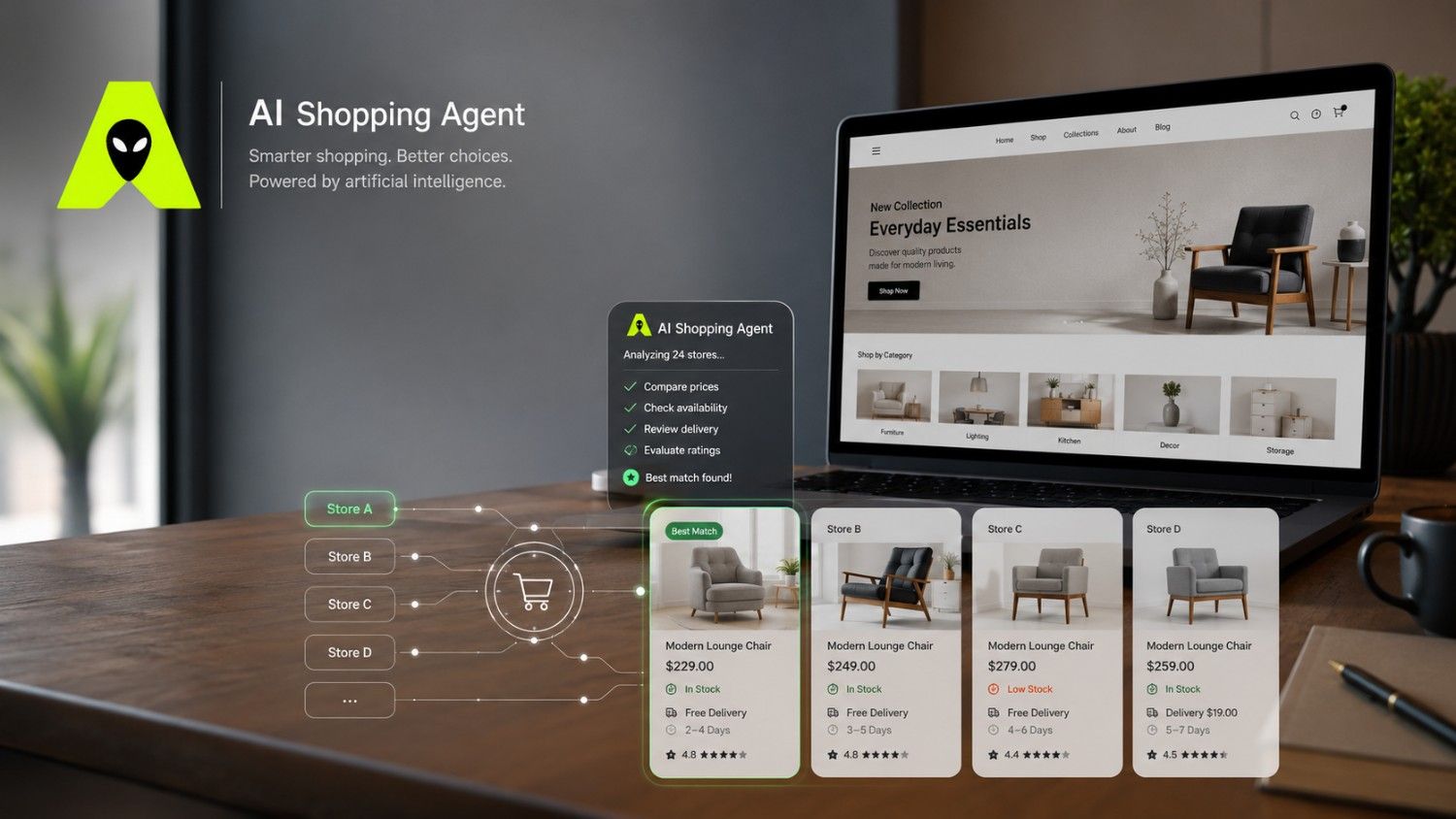
Shopify AI shopping is not just a feature update — it is a fundamental change in how transactions happen. Traditionally, a customer visited your store, browsed products, read descriptions, and made a decision. Now, AI agents do much of that cognitive work on their behalf.
Shopify has responded with a set of tools built specifically for this era. The Shopify Catalog API lets AI systems read your product data in a structured, machine-friendly format. The Unified Commerce Platform (UCP) connects your inventory, pricing, and fulfilment into a single data layer that AI agents can query in real time. Together, these tools make your store legible to the AI systems that are increasingly making buying decisions.
The stakes are real. Stores that implement these tools correctly become preferred sources for AI-driven purchases. Those that do not get filtered out — not by the customer, but by the AI acting on their behalf.
Understanding the technical side does not require a developer background. Think of the Shopify Catalog API as a structured menu that AI agents can read instantly. Instead of scraping your website visually, an AI agent calls this API, gets your full product catalogue in a clean data format, and processes it in milliseconds.
The Shopify UCP — Unified Commerce Platform — goes further. It connects your online store, physical retail, wholesale channels, and third-party platforms into one data source. As a result, when an AI agent asks "does this store have this product in stock and can it deliver to Bengaluru by Thursday," your UCP can answer that question accurately and instantly. Without it, the AI gets incomplete data and moves on to the next store.
Here is the part that surprises most store owners: AI agents for e-commerce do not judge your store the way a human does. They do not care about your brand story, your banner image, or your homepage layout. Instead, they evaluate a very specific set of data signals — and they do it in seconds.
Trust signals matter enormously. An AI agent cross-references your store against review data from Google, Trustpilot, and platform-native ratings. Moreover, it checks whether your business information is consistent across the web — the same name, address, contact details, and return policy appearing on your website, Google Business Profile, and social channels. Inconsistencies reduce your trust score and lower the likelihood of being selected.
Response speed also plays a role. Stores with fast API response times and reliable uptime are preferred over those with slow servers or frequent downtime. This is one reason why Shopify's own infrastructure gives hosted stores an inherent advantage over custom-built platforms when it comes to AI agent compatibility.
For businesses across India — whether you sell on Shopify from Delhi, Jaipur, Kolkata, or Coimbatore — the AI shopping shift creates a genuinely level playing field. A small, well-structured store with complete product data, clean reviews, and a properly configured Catalog API can out-compete a large brand whose product data is inconsistent or incomplete. Furthermore, regional language support, local payment methods like Razorpay and UPI, and accurate GST invoicing built into your Shopify store make your listings more trustworthy to AI agents evaluating Indian purchase requests. Our Shopify development team builds these data structures into every store we deliver — because the architecture decisions made at build time determine how visible you are to AI agents at sale time.
One of the most common questions we hear from store owners is this: does Shopify AI commerce replace SEO? The honest answer is no — but it extends what SEO means in a significant way.
Traditional SEO optimises your store for human searchers clicking on Google results. AI commerce optimisation, by contrast, ensures your store is readable, trustworthy, and data-complete enough for AI systems to select it automatically. Both matter. Additionally, the underlying principles are consistent: accurate information, structured content, fast performance, and genuine customer trust signals remain the foundation of visibility — whether the reader is a human or an AI agent.
What changes is the emphasis. Product schema and structured data — which many SEO strategies treated as optional — become non-negotiable in an AI commerce environment. Review signals that used to be a ranking factor now determine whether an AI agent includes your store in a purchase recommendation at all. And page speed, which Google has long rewarded in rankings, now directly affects whether your API responses are fast enough for AI agents to bother querying you. If you want to understand how these shifts connect to the broader AI search landscape, our guide on how AI search marketing has changed the customer journey covers the full picture.
Shopify agentic commerce refers to the ability of AI agents — acting on a customer's behalf — to browse, compare, and purchase products from Shopify stores without the customer manually clicking through each step. It works through Shopify's Catalog API and UCP, which give AI systems structured, real-time access to your product data, pricing, inventory, and fulfilment options. Stores with complete, well-structured data are far more likely to be selected by these agents than those with thin or inconsistent listings.
Not necessarily. Many of the most important steps — completing product attributes, syncing inventory, adding metafields, and keeping your Google Business Profile accurate — can be handled through Shopify's admin interface without code. However, configuring the Catalog API, implementing structured product schema, and integrating real-time fulfilment data typically benefit from professional setup. Our e-commerce development team handles the technical configuration so you can focus on the products themselves.
Voice search connects local customers to nearby businesses through spoken queries — "best bakery near me in Chandigarh." AI shopping agents, by contrast, operate across geographies and complete full transactions, not just discovery. However, both rely on the same underlying trust signals: complete business information, consistent citations, strong reviews, and structured data. A business that invests in one benefits from both. For a deeper look at local signals specifically, our guide on AI local search and local SEO covers this in detail.
API access is available on all Shopify plans, though the capabilities and rate limits vary by tier. Shopify Plus offers the most comprehensive API access, higher call limits, and dedicated support for enterprise integrations — which is particularly relevant for large catalogues and high-volume AI agent queries. For smaller stores, the standard API provides more than enough functionality to become AI-agent ready with the right configuration.
No — and it is worth being clear about that. AI agents handle routine, repeatable purchases where the criteria are well-defined: reordering supplies, finding the lowest price on a known product, or fulfilling a specific brief. Discovery shopping — browsing for inspiration, exploring new brands, or making high-consideration purchases — remains deeply human. The opportunity for store owners is to serve both: structured enough for AI agents to transact efficiently, compelling enough for human shoppers to choose you when they do browse.
Shopify AI commerce is not a feature you opt into later — it is a direction the entire e-commerce industry is moving. The stores that structure their data, complete their product attributes, and build consistent trust signals now will have a natural advantage as AI agents become a larger share of the purchase journey.
The fundamentals have not changed: good products, accurate information, and genuine customer trust still win. What has changed is how those qualities are communicated — increasingly through structured data and APIs rather than beautiful design alone.
If you want to make your Shopify store genuinely AI-ready, explore our Shopify development services or get in touch with the Alien Web Solutions team. We work with stores across India and internationally to build the data architecture that AI agents — and human customers — respond to.
