

Most people have not fully registered how fast search is changing. You used to type a query, scan the results, click a few links, and piece together an answer. That process is becoming outdated quickly.
Today, a growing share of users skip the results page entirely. They ask an AI assistant, get a direct answer, and move on. No scrolling. No clicking through five tabs. Just a question and an answer.
For businesses that rely on organic traffic, this is a serious shift. The future of SEO looks different from what most brands have been building toward — and understanding AI agents SEO is the clearest path forward.
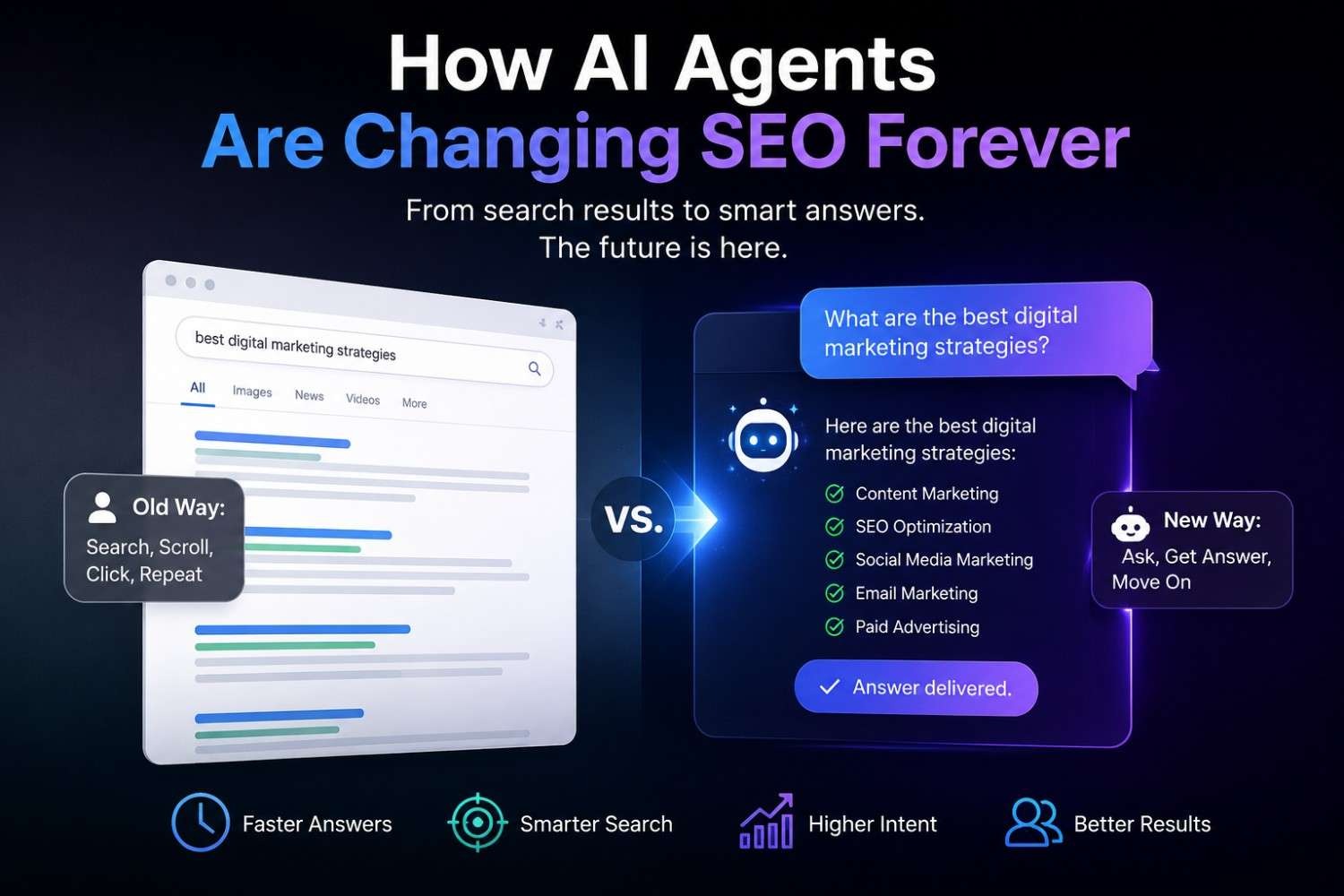
AI agents SEO is the process of optimizing your website so AI-powered tools — like ChatGPT, Perplexity, and Google's AI Overviews — actively cite and recommend your content. The future of SEO is shifting away from pure rankings toward earning trust, demonstrating authority, and making content easy for AI systems and humans to understand equally well.
An AI agent is a software system that can think, search, compare, and act on behalf of a user. It goes beyond answering questions. It can browse the internet, filter information across multiple sources, and deliver one clear, consolidated answer — often without the user doing anything beyond asking.
Tools like ChatGPT, Perplexity, and Google's AI Overviews are early examples. More advanced agentic AI systems can take real actions — booking, comparing products, filling forms — entirely on a user's behalf. They evaluate which content is credible, relevant, and clearly written — and they present that as the answer. Your website is not just being ranked. It is being judged.
"The old game was ranking pages. The new one is earning trust."
Traditional SEO was a race for position. Rank higher, get more clicks. The formula was clear.
AI search is a competition for credibility. When a user asks an AI tool something, the system reads content from across the web, weighs what is accurate and trustworthy, and synthesizes a response. The user may never visit your website directly. But if the AI regularly cites your content, you still gain real visibility and brand recognition.
You can hold the top position on Google and still be invisible to users who rely on AI tools for research and discovery. That is exactly why AI search optimization has become a priority — not an optional extra.
Research consistently shows AI-powered tools are cutting into traditional search traffic. The brands adapting now will capture that audience. The ones waiting will find the gap harder and harder to close.
SEO is not disappearing. It is expanding in ways most brands are not yet prepared for.
In the world of AI agents SEO, the rules have shifted. Citations matter more than click-through rates. Content quality matters more than keyword frequency. Trust signals matter more than technical tricks alone.
AI tools look for content that is specific, factual, and clearly structured. They skip vague overviews and generic summaries. If your content cannot directly answer a real question with clarity and authority, it will not appear in AI-generated responses.
At Alien Web Solutions, our web design and web application development services are built around this — creating digital properties that are technically clean, fast-loading, and structured in ways AI tools can read and trust.
Google's EEAT framework — Experience, Expertise, Authoritativeness, and Trustworthiness — has never mattered more. AI systems are trained to weight credible, well-sourced content more heavily. Brands with genuine expertise, consistent publishing records, and a clear point of view are far more likely to be cited in AI responses.
Thin content and anonymous publishing will be left behind. Real insight from real people with demonstrated experience — that is what earns trust from both readers and AI tools. For the official standard, Google's Search Quality Evaluator Guidelines are essential reading.
Low-effort, generic content looks identical to thousands of other pages. Both humans and AI systems have gotten good at identifying it — and ignoring it.
Every UI/UX design project and CMS platform we build at Alien Web Solutions is structured around clarity, credibility, and authority. See real examples in our project portfolio.
AI systems parse heading structure to understand what a page covers. Be clear and accurate in every heading — not clever. Vague headings actively work against you in AI search.
Think about what a user genuinely needs to know. Answer it directly and completely. This is the heart of good AI search optimization — and it works for human readers just as well.
Schema markup helps AI crawlers categorize your content correctly. Start with Article, FAQ, and LocalBusiness schemas. For further guidance, Search Engine Journal and Ahrefs' SEO Blog are excellent ongoing references.
Connect related pages deliberately. A well-linked site signals depth and expertise to both search engines and AI agents. Contact our team to discuss how we structure sites for maximum AI and SEO performance.
AI agents will keep reshaping how people find brands, products, and information. The future of SEO is no longer just about Google rankings — it is about being the trusted source that AI tools choose to cite.
The brands adapting now will build compounding advantages in visibility, authority, and trust. The ones waiting will find that gap increasingly difficult to close.
Ready to build a website that performs in AI-powered search? Explore Alien Web Solutions' services — or view our portfolio to see what we've built.
